Market Insights
Florida Amendment 3 Results: What They Mean for Rental Property Owners
Amendment 3 passed. Here’s how Florida’s new 5% non-homestead property tax cap affects rental property owners, when it starts, and what it does to your DSCR.
Florida voters approved Amendment 3 on November 3, 2026, with about 62% of the vote according to unofficial results. Constitutional amendments in Florida need 60% to pass.
Most coverage has focused on the larger homestead exemption for primary residences. Rental and investment properties don’t qualify for that exemption, but Amendment 3 does include a change aimed directly at them: a lower non-homestead property tax cap Florida investors need to understand.
This article explains what changed for non-homestead property, when it takes effect, and how to factor it into your rental numbers. Whether you supported the amendment or not, the goal here is to explain how it works so you can plan.
What Florida Amendment 3 means for investors at a glance
- Homestead exemption: It doesn’t apply to rentals. The larger exemption ($150,000 in 2027, rising to $250,000 in 2028) covers only owner-occupied primary residences.
- Non-homestead cap: It drops from 10% to 5%. Starting in 2027, the assessed value of rental, commercial, and other non-homestead property can rise by no more than 5% a year for non-school taxes.
- School taxes: They’re unchanged. The cap applies to non-school levies only.
- Timing: The amendment takes effect January 1, 2027. You’ll first see the effect on your TRIM notice and November 2027 tax bill. Your November 2026 bill is unaffected.
- Details still pending: The Legislature is expected to pass implementing legislation, and some details may change how the rules are applied.
The new non-homestead property tax cap Florida: 10% to 5%
Florida already limited annual increases in the assessed value of non-homestead property to 10% for non-school taxes. Amendment 3 cuts that limit in half.
In practice, if your rental’s market value jumps 9% in a year, your assessed value for non-school taxes can only rise 5%. Under the old 10% cap, the full 9% would have flowed through.
Four points are easy to miss:
- The cap limits assessed value, not your tax bill. Your bill is your taxable value times the millage rate. Local governments keep their authority to set millage within existing constitutional limits, so a bill can still rise faster than 5% if rates go up.
- It only matters when values rise faster than 5%. In a flat or declining market, the cap does nothing.
- School taxes aren’t capped for non-homestead property. That part of your bill can still follow market value.
- Property sales typically reset the assessment. Under current Florida law, a non-homestead property is generally reassessed at market value when ownership changes. Confirm with your property appraiser how it applies to a property you’re buying.
What stays the same for rental owners
- Rental properties still don’t qualify for homestead exemptions.
- Non-ad valorem assessments (such as stormwater or solid waste fees) aren’t affected by the cap.
- Local governments set their 2027 budgets and millage rates under the new rules, and those decisions will shape your actual bill.
How the change could affect your DSCR
If you finance rentals with a DSCR loan, property taxes are part of the debt payment your rent has to cover. The formula is:
DSCR = monthly rent ÷ monthly PITIA (principal, interest, taxes, insurance, and association dues)
Here’s a simple, hypothetical example to show how the cap can move the ratio over time. The millage rates, growth rates, and other figures are illustrative only. Your property’s numbers will differ.
Today
- Assessed value: $300,000
- Millage: 12 mills non-school + 6 mills school (illustrative)
- Property taxes: $5,400/year ($450/month)
- Principal and interest: $1,350/month
- Insurance: $350/month
- Rent: $2,400/month
- PITIA = $1,350 + $450 + $350 = $2,150
- DSCR = $2,400 ÷ $2,150 = 1.12
Five years later, assuming market value grows 8% a year, rent grows 3% a year, and millage and insurance stay flat:
| Old 10% cap | New 5% cap | |
|---|---|---|
| Non-school assessed value | $440,798 | $382,884 |
| School assessed value | $440,798 | $440,798 |
| Annual property tax | $7,934 | $7,239 |
| Monthly property tax | $661 | $603 |
| Monthly PITIA | $2,361 | $2,303 |
| Monthly rent | $2,782 | $2,782 |
| DSCR | 1.18 | 1.21 |
In this scenario, the lower cap saves about $58 a month by year five and adds about 0.03 to the DSCR. That’s not dramatic, but it compounds the longer you hold and the faster values climb. It can make a difference on a deal sitting close to a lender’s minimum ratio.
The same example shows the cap’s limits. If your county raises its millage rate, or your insurance premium rises, those changes can easily outweigh the savings from the cap.
For a broader comparison of product types, see DSCR vs Hard Money: Which Loan Fits Your Investment Deal?.
Practical steps for rental property owners
- Run your numbers with realistic tax assumptions. Use your current assessed value, your county’s actual millage rates, and a few different growth scenarios.
- Watch your county’s 2027 budget process. Local revenue decisions over the next year will affect millage rates.
- Check your 2027 TRIM notice in August 2027. That’s the first time you’ll see the new cap applied to your property.
- When buying, budget for reassessment. Base your projected taxes on the purchase price, not the seller’s current tax bill.
- Follow implementing legislation. The Legislature may clarify how the amendment is applied, and the governor has said he plans a special session to address Amendment 3.
How people view the amendment
Supporters argue Amendment 3 brings meaningful tax relief and that the lower non-homestead cap makes rental and business costs more predictable. Opponents, including many local government officials, argue the revenue losses could lead to cuts in local services, higher fees, or higher millage rates, and some analysts say the tax burden could shift toward renters and businesses. How it plays out will depend largely on decisions local governments and the Legislature make over the next two years.
Frequently asked questions
Can the new tax cap improve my DSCR loan qualification?
Possibly, but mostly over time rather than right away. The cap slows how fast the non-school portion of your property taxes can grow when values rise more than 5% a year, which keeps PITIA lower and DSCR higher than it would otherwise be. Lenders generally underwrite using actual or estimated current taxes, so the cap doesn’t change a ratio on day one, and millage or insurance increases can outweigh it. A DSCR specialist can show how it affects a specific deal.
Will buying a rental property reset its assessed value?
Generally, yes. Under current Florida law, non-homestead property is typically reassessed at market value when ownership changes, and the cap then limits increases from that new base. The amendment’s ballot summary doesn’t address this, so confirm with your county property appraiser and budget taxes based on the purchase price, not the seller’s current bill.
Does the amendment affect school district taxes?
Not for non-homestead property. The 5% cap applies only to non-school levies, so the school portion of a rental’s tax bill can still follow market value. For homesteads, the larger exemption also applies only to non-school taxes, while a $25,000 exemption continues to apply to school taxes.
Will my property taxes automatically decrease in 2027?
No. For rental property, the amendment limits how fast assessed value can rise; it doesn’t cut the value or the bill. Your bill can still increase if values rise, if millage rates go up, or if non-ad valorem fees change. In a flat or falling market, the cap has little or no effect.
Does the 5% cap apply to commercial investment properties?
Yes. The cap covers non-homestead property, which includes commercial, industrial, and rental property, for non-school levies.
When does the new 5% non-homestead property tax cap begin?
The amendment takes effect January 1, 2027, and applies beginning with the 2027 tax roll. Owners will first see it on TRIM notices in August 2027 and on tax bills issued in November 2027. November 2026 tax bills are not affected.
Does Amendment 3 apply to rental properties in Florida?
Yes, through the non-homestead cap. Rental properties don’t qualify for the larger homestead exemption, but their annual assessed-value increases for non-school taxes are now capped at 5% instead of 10%.
Planning Your Next Florida Investment?
Understanding property taxes is an important part of evaluating any rental property investment. Whether you’re purchasing a new rental, refinancing an existing property, or expanding your portfolio, having the right financing strategy matters.
At Reward Services, we help real estate investors explore financing solutions for rental and investment properties.
Looking for financing for your next investment? Explore our DSCR loan programs or contact Reward Services to discuss your financing options.
Sources
- Pinellas County Property Appraiser: Amendment 3 legislative update
- Florida Chamber of Commerce: Amendment 3 resource center
- Florida Department of State: official amendment information
- Orange County Government: Property Tax Amendment 3
Disclaimer: This article is for general informational purposes only and is not tax, legal, or financial advice. Property tax outcomes depend on your property, your county’s millage rates, and implementing legislation that has not yet been passed. Consult your county property appraiser or a qualified tax professional about your situation.
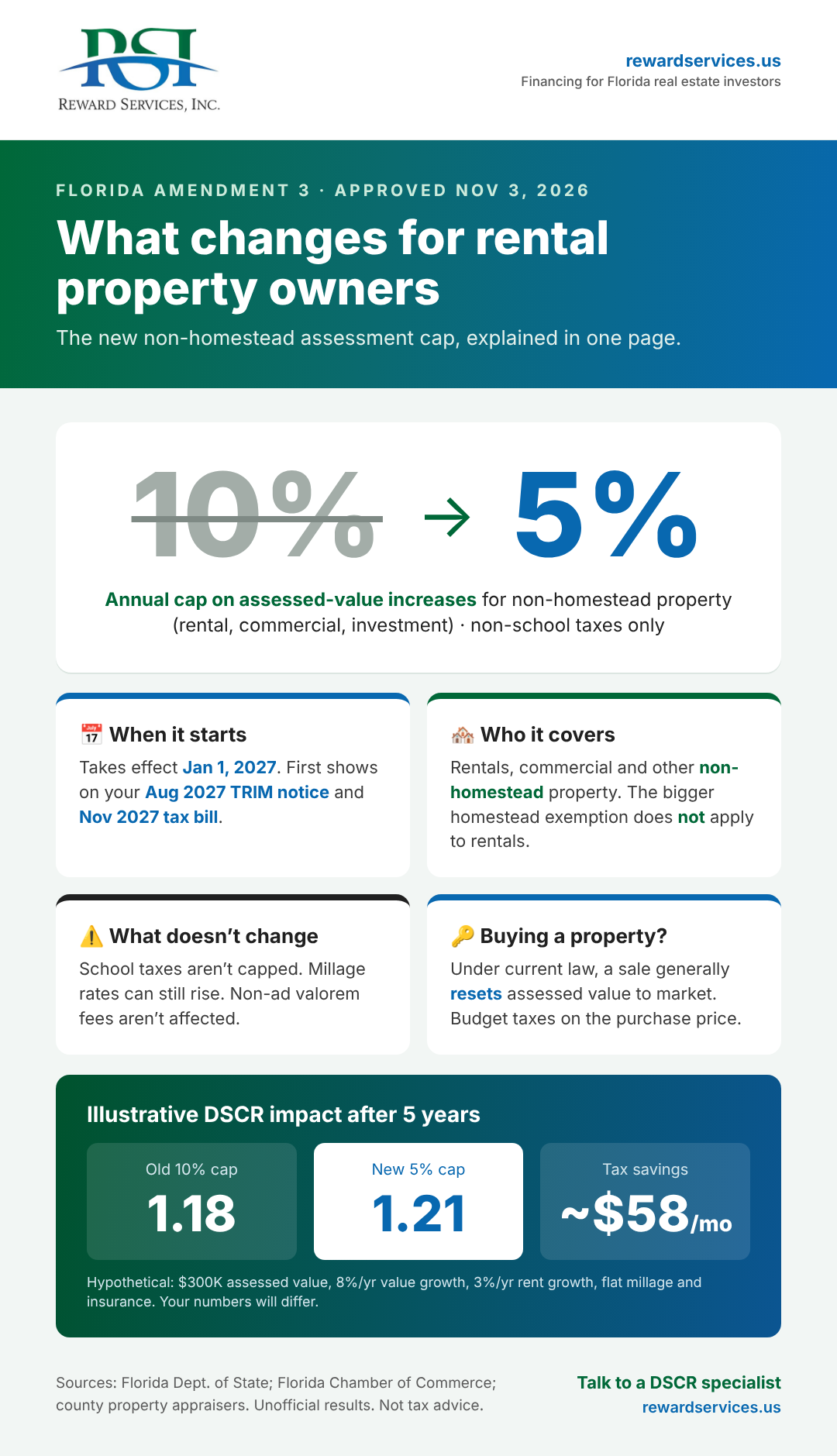
Amendment 3 at a glance: infographic
Save or share this one-page summary of what Amendment 3 changes for rental property owners.
Download the full-size infographic (PDF)
Enter your email and we'll unlock the download, plus occasional updates on Amendment 3 for Florida investors.